
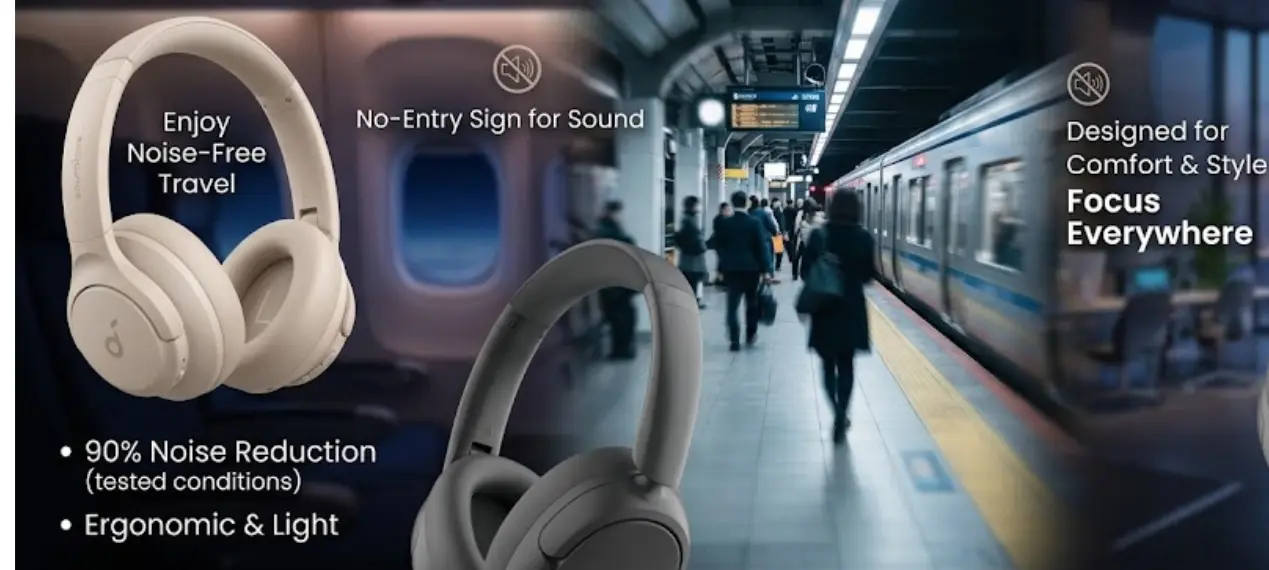
If you search for Best ANC Headphones Under $50 for Travel, then don’t worry; you are in the right article
Good noise-cancelling headphones used to cost $300 or more. But today you can find solid active noise-cancelling (ANC) over-ear headphones for less than a restaurant dinner.
But carefully. The market is full of big claims and thin results. Some headphone brands say “ANC” on the box and barely do anything.
So I went through manufacturer specs, retailer listings and independent reviews to find the best ANC headphones under $50 for travel. Three best models stood out: the TOZO HT3, the Soundcore Q20i and the JLab JBuds Lux ANC.
Here is what each one does well, where each one falls short, and which one fits your trip.
Quick Answer: Which Are the Best ANC Headphones Under $50 for Travel?
- Best overall for travel: TOZO HT3. It has the longest battery life and the strongest noise-cancelling in this price range, according to testing.
- Most comfortable: Soundcore Q20i. It has a lighter clamp and soft cushions.
- Best for features: JLab JBuds Lux ANC. It has multipoint, a companion app and rotating earcups, but it often costs a little over $50.
Table of Contents
Quick Product Overview Table
| Feature | TOZO HT3 | Soundcore Q20i | JLab JBuds Lux ANC |
|---|---|---|---|
| Type | Over-ear, foldable | Over-ear, foldable | Over-ear, foldable |
| ANC | Hybrid ANC (up to 45 dB claimed), adaptive ANC | Hybrid ANC, transparency mode | Hybrid ANC, transparency mode |
| Battery (ANC on) | Up to 55 hours | Up to 40 hours | Up to 40+ hours |
| Battery (ANC off) | Up to 90 hours | Up to 60 hours | Up to 70+ hours |
| Two devices at once | Yes | Yes (multipoint) | Yes (multipoint) |
| Wired option | 3.5 mm cable and USB audio | 3.5 mm cable | USB-C wired audio |
| Companion app | Yes (32 EQ presets) | Yes (custom EQ) | Yes (JLab app) |
| Typical price range* | About $30–$50 | About $38–$45 | About $47–$50 (list price is $49.99) |
*Prices change often. These are the ranges I saw in October 2026.
How I Picked These Headphones
I did not want a list of random bestsellers. I used five filters:
- Real ANC. The headphones must have active noise cancelling, not just a tight fit.
- Battery. Travel days are long, so I looked for at least 40 hours with ANC on.
- Comfort. Over-ear designs only, because on-ear models tend to squeeze your ears on long flights.
- Price. Each pair had to sell for $50 or less, at least during regular sales.
- Evidence. I leaned on specs from the makers and on reviews from independent testers who bought or tested the products.
Quick Product Overview Table
| Feature | TOZO HT3 | Soundcore Q20i | JLab JBuds Lux ANC |
|---|---|---|---|
| Type | Over-ear, foldable | Over-ear, foldable | Over-ear, foldable |
| ANC | Hybrid ANC (up to 45 dB claimed), adaptive ANC | Hybrid ANC, transparency mode | Hybrid ANC, transparency mode |
| Battery (ANC on) | Up to 55 hours | Up to 40 hours | Up to 40+ hours |
| Battery (ANC off) | Up to 90 hours | Up to 60 hours | Up to 70+ hours |
| Two devices at once | Yes | Yes (multipoint) | Yes (multipoint) |
| Wired option | 3.5 mm cable and USB audio | 3.5 mm cable | USB-C wired audio |
| Companion app | Yes (32 EQ presets) | Yes (custom EQ) | Yes (JLab app) |
| Typical price range* | About $30–$50 | About $38–$45 | About $47–$50 (list price is $49.99) |
How I Picked These Headphones
I did not want a list of random bestsellers. I used five filters:
- Real ANC. The headphones must have active noise cancelling, not just a tight fit.
- Battery. Travel days are long, so I looked for at least 40 hours with ANC on.
- Comfort. Over-ear designs only, because on-ear models tend to squeeze your ears on long flights.
- Price. Each pair had to sell for $50 or less, at least during regular sales.
- Evidence. I leaned on specs from the makers and on reviews from independent testers who bought or tested the products.
Key Features
What You Get Under $50
Budget ANC headphones have improved a lot. All three picks share a similar base:
- Hybrid ANC. This uses microphones inside and outside the ear cups to listen for noise and cancel it.
- A transparency mode. It lets outside sound in, which helps when you need to hear an announcement.
- Foldable bodies. They pack down for a carry-on bag.
- Two-device connection. You can stay linked to a phone and a laptop together.
- USB-C charging. One cable is enough for most travellers.
What Sets Each One Apart
TOZO HT3. Battery life is the headline. TOZO lists up to 90 hours with ANC off and 55 hours at maximum noise cancelling, from a 500 mAh battery. The listing also mentions Bluetooth 6.0, five microphones and 32 EQ presets.
Soundcore Q20i. This model focuses on comfort and balance. It supports Soundcore’s app, a custom EQ and fast charging, where five minutes gives about four hours of playback.
JLab JBuds Lux ANC. It adds rotating earcups, Bluetooth multipoint and spatial audio compatibility. JLab states 10 minutes of charging gives about four hours of playtime.
Design & Build Quality
At this price, build quality is where brands cut corners. The good news is that these three feel better than the usual budget fare.
The TOZO HT3 uses a matte plastic finish with simple branding. One reviewer described the look as understated, which suits an office or a flight. An independent tester also said the TOZO and Soundcore felt sturdier than the plasticky on-ear models from JBL and Sony.
The Soundcore Q20i is a plain, lightweight design. It folds, but the carrying case is not included in some regions, so you may want a small pouch.
The JLab JBuds Lux ANC has a foldable headband and earcups that rotate flat. That helps when you wear them around your neck between flights. One retailer lists its weight at 236 g.
Quick take: none of these will feel like premium metal-and-leather headphones. They are plastic, and that keeps them light.
Comfort for Long Usage
Comfort matters more than most people think. A 10-hour flight is a long time to wear anything on your head.
Soundcore Q20i: The Comfort Pick
An independent reviewer rated the Q20i the most comfortable headphone in its group. The reasons were the larger over-ear shape, a relaxed clamp and soft cushions. Another buying listing points to memory-foam cushions and a secure fit.
TOZO HT3: Firmer Grip
The same reviewer found the HT3 clamps more firmly. A second review noted that the grip eases a little after long sessions, but that also weakens the passive seal a bit. Some people like the secure fit. Others will want a break after a few hours.
JLab JBuds Lux ANC: Cushioned and Flexible
JLab uses a foam earcup design and a rotating hinge. Reviewers describe it as comfortable for daily use, and the rotation makes it easier to rest on your neck.
Tip: If you have a larger head or wear glasses, the lighter clamp of the Q20i is the safer bet.
Sound Quality
Do not expect studio-grade sound for $40. You can still expect something pleasant.
Overall Tone
All three lean toward a warm, bass-forward tuning. That works well for pop, hip-hop, podcasts and movies on a plane.
The Soundcore Q20i is described by reviewers as balanced for the price. An independent tester put the TOZO HT3 slightly ahead of the Q20i for sound, but also called its default tuning overly bass-heavy, with vocals that can sound less clear.
The App Fix
Both TOZO and Soundcore have apps with EQ controls. If the bass feels heavy, turn it down in the app. This one habit makes a bigger difference than most people expect.
JLab also offers customizable sound through its app. One technical note: JLab’s spec sheet lists SBC as its supported Bluetooth codec, so do not expect high-end wireless codecs.
Bass Performance
Bass is where cheap headphones try to impress you.
- TOZO HT3: Strong in quantity. A reviewer said the bass was looser and a bit muddier than a rival from JBL, but the app EQ can tighten it.
- Soundcore Q20i: Includes a “BassUp” feature. Reviewers call the overall sound balanced rather than boomy.
- JLab JBuds Lux ANC: Reviewers describe depth and clarity, with the sound adjustable through its app.
If you love heavy bass, the HT3 gives you the most to start with. If you prefer a calmer sound, the Q20i is the safer choice.
Noise Cancellation
This is the reason you are here, so let me be direct about what to expect.
Budget ANC does not match a $400 flagship. It reduces steady, low-pitched sounds, such as engine drone, air conditioning and train rumble. It does less with sudden sounds, like voices and clattering trays.
How They Compare
- TOZO HT3: One independent tester, who usually reviews $400+ headphones, called its ANC the best he had tested under $50. He said it is not at flagship level, but more than good enough for daily life and flights. TOZO claims up to 45 dB of reduction. Treat that as a lab-style claim, not a promise for real use.
- Soundcore Q20i: The same tester called it the only other real contender under $50, though a step behind the HT3. Opinions vary. One Swiss retailer’s reviews called the ANC fairly weak, while other buyers praised it.
- JLab JBuds Lux ANC: A German review site praised the noise cancelling as effective.
How to Get More Out of ANC
- Pull your hair back and keep glasses arms thin, so the cushions seal fully.
- Pick the right ANC mode in the app, if one is offered.
- Use music or a podcast. ANC plus low volume beats no ANC plus loud volume, and it is safer for your ears.
Battery Life
For travel, battery life may matter more than sound.
| Model | ANC on | ANC off | Fast charge |
|---|---|---|---|
| TOZO HT3 | Up to 55 hours | Up to 90 hours | Full charge in about 2 hours |
| Soundcore Q20i | Up to 40 hours | Up to 60 hours | 5 minutes gives about 4 hours |
| JLab JBuds Lux ANC | Up to 40+ hours | Up to 70+ hours | 10 minutes gives about 4 hours |
Those are manufacturer figures. Real-life performance depends on volume and settings. Even so, 40 hours is more than enough for a long-haul flight plus a layover. The HT3 is the pick if you hate remembering to charge.
Microphone Quality
Budget headphones are not built around call quality, but you can still use them.
- TOZO HT3: Lists five microphones with AI call noise reduction. That is the biggest mic setup of the three on paper.
- Soundcore Q20i: Soundcore’s own spec list shows a single microphone for calls.
- JLab JBuds Lux ANC: JLab advertises noise-cancelling microphones for calls.
I did not find a reliable independent mic test for all three, so treat these as feature lists, not proof of performance.
Connectivity & Bluetooth Features
All three connect to two devices at once. That is handy when you want to watch a movie on your tablet and still get a call on your phone.
| Feature | TOZO HT3 | Soundcore Q20i | JLab JBuds Lux ANC |
|---|---|---|---|
| Bluetooth version listed | 6.0 | 5.0 | 5.3 per JLab’s UK spec (listings vary) |
| Dual-device connection | Yes | Yes | Yes |
| Wired use | 3.5 mm and USB audio | 3.5 mm | USB-C |
Bluetooth version numbers differ between retailer pages for some models, so check the box or the maker’s page before you buy.
Travel tip: keep a 3.5 mm cable in your bag. Many aeroplane seat screens still use a headphone jack, and a wired connection works even if the battery dies. The HT3 and Q20i both support a 3.5 mm cable.
Gaming Performance
These are travel headphones first. They are not built for competitive gaming.
Bluetooth always adds some delay. I found no published latency tests for these three, so I will not quote numbers. For casual mobile games or video on a long trip, you will likely be fine. For fast shooters, use a wired connection instead. The HT3 and Q20i both accept a cable.
Calling Experience
Calls work, but they are not the strong point.
- Expect clear voice in a quiet room.
- Expect more background noise passing through in crowded spaces.
- The TOZO HT3’s five-mic design is the most promising on paper.
For important calls in a loud airport, a headset with a boom mic does better. For quick calls and video chats, any of these three will do.
Pros
TOZO HT3
- Longest battery life of the group
- Strongest ANC in this price range, according to one independent tester
- Wired and USB options
Soundcore Q20i
- Comfortable fit with soft cushions
- Fast charging
- Trusted brand with a polished app
JLab JBuds Lux ANC
- Good feature set, including rotating earcups and multipoint
- Long battery life
- Foldable and light
Cons
TOZO HT3
- Firmer clamp can tire some heads
- Default sound is bass-heavy and a little muddy
- Lesser-known brand
Soundcore Q20i
- ANC is a step behind the HT3, and some reviewers found it modest
- Single mic for calls
- Shorter battery life than the other two
JLab JBuds Lux ANC
- Often priced right at or above $50
- Lists SBC as its only codec
- Fewer independent test results than the other two
Comparison With Competing Products
Not every pair under $50 has ANC. Here is how three popular alternatives stack up.
TOZO HT3 vs JBL Tune 520BT
The JBL Tune 520BT is an on-ear model without ANC. One independent tester picked it for sound quality and clean, punchy bass. But it does not cancel noise, and on-ear designs can press on your ears. Choose it if sound matters more than silence. Choose the HT3 if you fly.
Soundcore Q20i vs Sony WH-CH520
The Sony WH-CH520 is light and cheap, and a reviewer liked it for workouts. It has no ANC, so engine noise stays loud. The Q20i is the better travel tool.
JLab JBuds Lux ANC vs JBL Tune 770NC
The JBL Tune 770NC does have ANC, but it lists around $90 in the tests I found. It is a good step up if you can spend more. If you cannot, the JLab covers much of the same ground for less.
Buying Guide: What to Consider Before Buying Travel Headphones
1. Real ANC vs. Passive Isolation
Passive isolation blocks sound with fit alone. Active noise cancelling uses microphones and processing. Look for the word “hybrid” and a clear ANC on/off control.
2. Battery Life With ANC On
Many ads quote the battery figure with ANC off. Always check the ANC-on number. For travel, I would not go below 30 hours.
3. Over-Ear vs. On-Ear
Over-ears wrap around your ears and spread the pressure. On-ears sit on top and may hurt after a couple of hours.
4. Comfort and Weight
Light headphones with soft cushions are easier on long trips. If you can, check how firm the clamp feels in reviews.
5. Wired Backup
A 3.5 mm or USB cable helps when the battery runs out and on in-flight entertainment systems.
6. Multipoint Connection
Two-device support means no switching between phone and laptop.
7. Foldable Design and Carry Case
Foldable hinges save space. A hard case adds protection, but not every pair includes one.
8. Warranty and Support
A longer warranty is a sign the brand stands behind it. JLab states a two-year warranty, for example.
Final Verdict
If I had to pick one pair for most travellers, I would choose the TOZO HT3. It pairs the strongest budget ANC I found in independent testing with outstanding battery life, and it often sells below $50.
If comfort is your top priority, go for the Soundcore Q20i. It has a gentler fit, a trusted brand and solid features at a similar price.
The JLab JBuds Lux ANC is a good option if you like its features and don’t mind paying right around $50 or slightly more.
None of them replaces a $300 pair of flagship headphones. But for the price of a few airport snacks, all three make travel noticeably calmer.
